
Boulder County Probate Court Records
Boulder County probate court records document estate settlements and protective proceedings in the foothills of Colorado. These records are maintained by the 20th Judicial District Court at the Boulder County Combined Court. Files include wills, estate inventories, guardianship appointments, and conservatorship orders dating back to 1862. Boulder County residents can access these probate records through the court's online systems or by visiting the courthouse on 6th Street.
Boulder County Probate Court Location
The Boulder County Combined Court handles all probate matters. The courthouse is located at 1777 6th Street in Boulder. This facility serves the entire county's court needs.
The main court telephone number is 303-441-3750. This line reaches the clerk's office for general inquiries. For records requests, email 20recordsrequest@judicial.state.co.us. This dedicated address handles document copy requests.
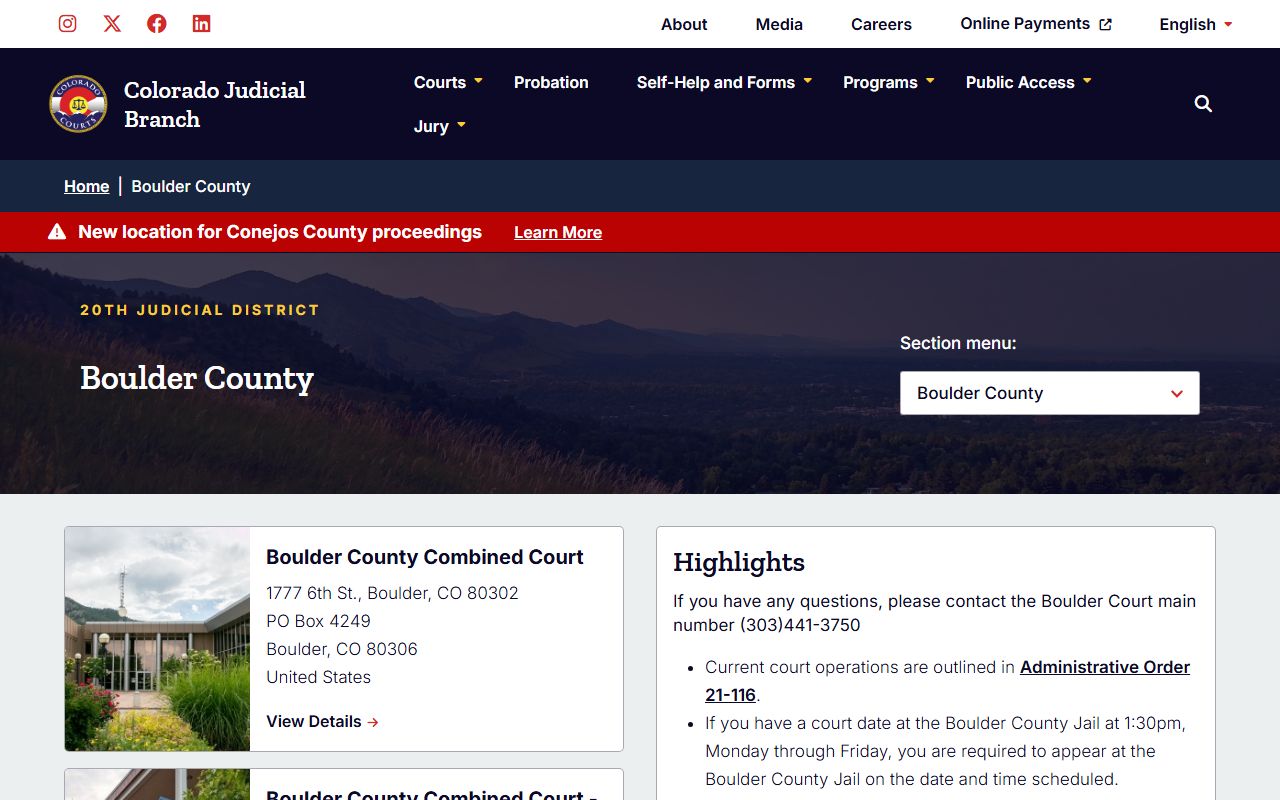
The Boulder County Trial Court page provides official court information and procedures.
Boulder County is the only county in the 20th Judicial District. This gives the court exclusive jurisdiction over local probate matters. The District Court handles all estates, guardianships, and conservatorships for Boulder County residents.
The courthouse operates during standard business hours. Call ahead to confirm record availability. Some older files may require advance notice to retrieve.
Boulder County Court Services
Boulder County offers various court-related services through multiple channels. These resources help residents navigate probate matters.
The Boulder County website provides court-related information at bouldercounty.gov/safety/court-related-services/. This page explains court procedures and available services. Residents can find guidance on probate processes and record access.
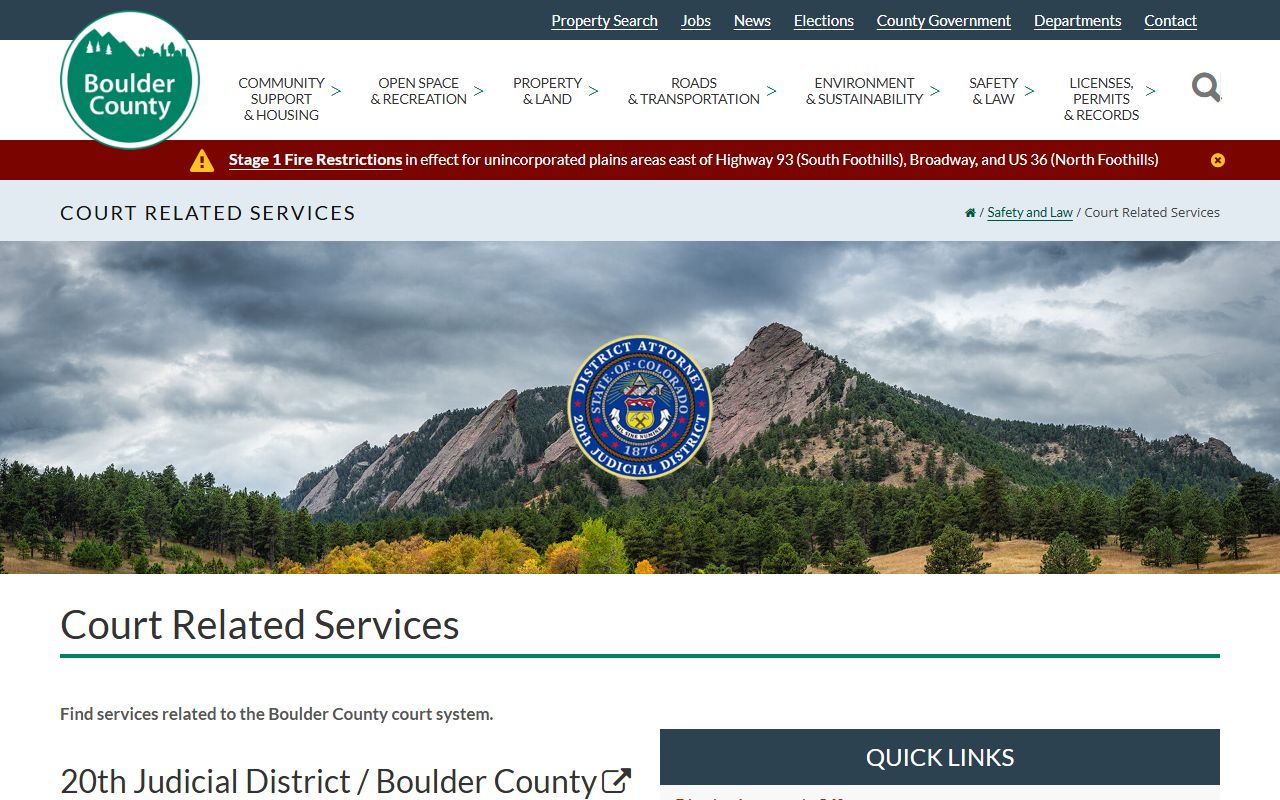
Boulder County provides court-related services information for residents.
The court offers self-help resources for probate matters. Forms and instructions are available online. Staff can answer procedural questions. Complex matters may require legal counsel.
How to Find Boulder County Probate Records
Several methods exist for locating probate records in Boulder County. The best approach depends on your specific needs.
The statewide docket search at coloradojudicial.gov/dockets covers Boulder County cases. This free tool shows basic case information. Search by name, case number, or date range. Results display filing dates and case status. Full documents require direct court contact.
In-person visits provide complete access to case files. Visit the Clerk of Court office during business hours. Staff will retrieve files for your review. You can request copies of any documents. Same-day service is often available.
Email is efficient for record requests. Send inquiries to 20recordsrequest@judicial.state.co.us. Include case details in your message. Staff will respond with next steps.
Historical records from 1862 through 2004 are stored at the Colorado State Archives. Search their database at archives.colorado.gov/archives-search. Contact the Archives for copies of older cases.
Types of Boulder County Probate Court Records
Boulder County probate courts handle diverse case types. Each generates specific documentation.
Estate administration settles affairs after death. The court supervises asset distribution to heirs and creditors. Case files include original wills, property inventories, creditor notices, and accountings. These documents reveal the full scope of the deceased's holdings.
Colorado offers two probate paths. Informal probate works when no disputes exist. The process is administrative. Formal probate requires court hearings and judicial oversight. This applies when conflicts arise.
Guardianship cases protect individuals unable to care for themselves. Conservatorship cases manage financial affairs for protected persons. Both require ongoing court supervision. Records detail the protected person's condition and financial status.
Small estate affidavits allow simpler transfers for estates under $80,000. No full probate is needed. The Colorado Probate Code establishes these simplified procedures.
Historical Boulder County Probate Records
Boulder County maintains one of the longest probate record collections in Colorado. Historical files span from 1862 to 2004.
The Colorado State Archives holds these older records. Their collection covers more than 140 years of Boulder County probate history. Researchers and genealogists frequently access these files.
Search the Archives database by name at archives.colorado.gov/archives-search. The system shows whether a file exists. Note the case number and year for requests.
To obtain copies, contact the Archives directly. Fees vary based on page count and certification needs. Processing times depend on file location.
Cases filed after 2004 remain at the courthouse. The District Court maintains these files on-site. Contact the court directly for recent records.
Requesting Boulder County Probate Records
The court offers multiple ways to request probate records. Choose the method that fits your situation.
Email is the preferred method for most requests. Send inquiries to 20recordsrequest@judicial.state.co.us. Include complete case details. Staff will respond with instructions.
The online records request form is available at coloradojudicial.gov/recorddocument-request-form. This works for all Colorado courts. Complete the form and submit electronically.
In-person requests work well for urgent needs. Visit the courthouse during business hours. The clerk can locate files quickly. Copies are often available while you wait.
Mail requests are accepted. Send detailed letters to 1777 6th Street, Boulder, CO 80302. Include all known case information. Allow processing time.
Nearby Counties
Boulder County is located in north-central Colorado. Several surrounding counties handle similar probate matters.